Buy europesname.eu ?
We are moving the project
europesname.eu .
Are you interested in purchasing the domain
europesname.eu ?
domain@kv-gmbh.de · 0541-91531010
Buy europesname.eu ?
What does Cuban cuisine and eating culture look like?
Cuban cuisine is a fusion of Spanish, African, and Caribbean influences, resulting in a diverse and flavorful culinary tradition. Common ingredients include rice, beans, plantains, and various meats such as pork and chicken. Popular dishes include ropa vieja (shredded beef), arroz con pollo (chicken with rice), and lechón asado (roast pork). Eating culture in Cuba is centered around family and community, with meals often being a social and communal experience. It is common for Cubans to share meals with extended family and friends, and food is an important part of social gatherings and celebrations. **
What are electricity and high culture history?
Electricity history refers to the development and use of electricity as a form of energy, including the discovery of electricity, the invention of electric devices, and the establishment of electrical systems. High culture history, on the other hand, refers to the history of cultural and artistic achievements that are considered to be of high quality and sophistication, such as classical music, literature, fine arts, and theater. Both electricity and high culture history have evolved over time, shaping the way we live and appreciate the world around us. **


Similar search terms for Garnacha-Prohibida-Ecologico-Bodegas
Top-Angebote
Products related to Garnacha-Prohibida-Ecologico-Bodegas:
-
Toro 'Joven Ecologico' Bodegas Piedra 2023The Toro ‘Joven Ecologico’ from Bodegas Piedra is a label that showcases the most accessible and youthful aspect of the Spanish denomination Toro. The Tinta de Toro, the variety at the base of the denomination, represents a clone of Tempranillo, the most widespread grape variety throughout Spain. The Tinta de Toro biotype is distinguished by the smaller size of the bunches, a characteristic that leads to the production of wines that are generally more concentrated than those of the “classic” Tempranillo. Bodegas Piedra Toro ‘Joven Ecologico’ comes from only Tinta de Toro grapes sourced exclusively from the Pago de Cantadal vineyard, where the vines are over 20 years old. The soils, of alluvial origin, have a mixed texture while the agronomic management follows the principles of certified organic farming. During the second half of September, manual harvesting of the bunches takes place, which are then subjected to strict quality control before red winemaking through alcoholic fermentation in stainless steel tanks.of stainless steel at controlled temperature in contact with the skins. The malolactic fermentation and the subsequent maturation of a few months that precedes bottling also take place in stainless steel. Visually, the ‘Joven Ecologico’ Bodegas Piedra Toro shows an intense cherry red color. On the nose, pleasant fruity sensations of strawberry, raspberry, and currant are perceived, surrounded by delicate floral hints and Mediterranean herbs. Fresh and juicy on the palate, very smooth and balanced, with a non-intrusive tannin that accompanies the fruity finish. Due to its dynamism and immediacy, the ‘Joven Ecologico’ is an excellent pairing with medium-aged cheese and cold cuts platters or with first and second courses based on white meats.11,00 £*Shipping: 48,00 £Secure redirect to the provider
-
Barbera e Garnacha Erasmo 2019“Barbera Garnacha” from the Chilean winery Erasmo is an original and unique blend, capable of uniting even three different worlds, both geographically and in terms of winemaking tradition: the flagship grape of the hills of Piemonte, Barbera, is linked to the navigator of the Mediterranean, Grenache, in a vinification conceived from the other side of the Atlantic. A red of great pleasure, which tells something more about the wine surprises that a country like Chile still has in store. The Erasmo winery produces its “Barbera Garnacha” from the homonymous varieties typical of very distant latitudes, but which have found a decidedly suitable habitat in Chile, of which the Valle de Maule represents the oldest and most extensive wine region. The plots from which the grapes come are located in the Reserva de Caliboro, on the gentle slopes of the central valley of the Maule region: they are alluvial soils, formed by the debris deposited by the flow of the Perquilauquen river. Surprisingly, this region receives no oceanic influence, because the opening towards the coast is blocked by significantly higher elevations: the climate here is typically Mediterranean, with advantageous temperature excursions due to the strong sunlight and the currents that sweep across the plain coming from the Andes. The harvest is carried out by hand at the beginning of April and in the winery, the division into two distinct masses takes place: the first part consists of grapes for blending, while the second half is represented by grapes vinified separately. All fermentations are spontaneous, carried out by indigenous yeasts and take place in stainless steel tanks, with brief macerations on the skins. At the end of the autumn season, the final blending is carried out, which will see Barbera present for 66% and Garnacha for 34%, inside new stainless steel containers that will subsequently be placed at low temperatures for about 45 days, in order to naturally stabilize the wine.the tasting is juicy and very fresh, youthful in its fruity hints but with a tannin that is already soft and mature. A red that can represent a good aperitif or accompany fish soups and grilled meats.16,00 £*Shipping: 48,00 £Secure redirect to the provider
-
Garnacha 'Azuda' Clos de Luz 2020The Garnacha "Azuda" by Clos de Luz originates in the Almahue Valley in Chile, a small area dedicated to wine production halfway between the Pacific Ocean and the Andes. The winery has been managed for five generations by the Edward Cosmelli family, who, with grandmother Luz, began planting the first historic vineyards and revitalized the Carmenere grape, present in this area since the times of Spanish colonization. The working philosophy pursues the idea that human intervention should be minimized, following the natural phases of growth, development, and maturation of both the plants and the grape clusters, thus preserving biodiversity in the interest of excellent vineyard development. The pure Garnacha grapes of the Garnacha "Azuda" by Clos de Luz are cultivated in soils predominantly composed of quartz and oxidizing iron, which give rise to wines with a unique character. "Azuda" recalls the name of the century-old hydraulic wheels located near the winery and considered a historical monument of the area: they were built to irrigate constantly and abundantly the crops and represent a symbol of innovative ingenuity against human limitations. The climate is predominantly Mediterranean with abundant winter rains and mild temperatures both in summer and winter; thanks to the wide temperature range between day and night, perfect ripening of the grapes is achieved. The harvesting process is manual in October; in the winery, fermentation is spontaneous and aging takes place in wood for 12 months, in order to preserve the original fruit aromas. The color of the Garnacha "Azuda" by Clos de Luz is garnet red with brilliant reflections; on the nose, one can recognize aromas of red fruit with a mix of floral and spicy notes. On the palate, it is enveloping, elegant with a good tannic structure and a final freshness that balances everything. It pairs perfectly with grilled and stewed red meat, game, and first courses seasoned with seasonal vegetables. A product to be kept in your personal cellar and to be consumed on family lunches to celebrate anniversaries and anniversaries, enjoying a product with immense potential.30,00 £*Shipping: 48,00 £Secure redirect to the provider


-
What is the difference between low culture and high culture in history?
Low culture refers to the cultural activities and products that are considered to be more common, popular, and easily accessible to the general public. This can include things like popular music, television shows, and mass-produced literature. On the other hand, high culture refers to the cultural activities and products that are considered to be more refined, sophisticated, and often associated with the elite or educated classes. This can include things like classical music, fine art, and literature that is considered to be more intellectually challenging. The distinction between low and high culture has been a source of debate and has evolved over time, but it generally reflects the social and class divisions within a society. **
-
Does anyone know about the Islamic Golden Age in architecture and culture?
Yes, the Islamic Golden Age was a period of great cultural and architectural achievements in the Islamic world, spanning from the 8th to the 14th century. During this time, Islamic scholars made significant advancements in fields such as mathematics, astronomy, medicine, and philosophy. In terms of architecture, the Islamic world produced stunning examples of mosques, palaces, and other structures, characterized by intricate geometric patterns, domes, and arches. This period also saw the development of beautiful decorative arts such as calligraphy, ceramics, and textiles. Overall, the Islamic Golden Age left a lasting legacy in both architecture and culture. **
-
What are examples of natural landscapes and cultural landscapes?
Examples of natural landscapes include mountains, forests, deserts, beaches, and rivers. These landscapes are shaped by natural processes such as erosion, weathering, and tectonic activity. On the other hand, cultural landscapes are areas that have been influenced or shaped by human activity, such as cities, agricultural lands, parks, and historic sites. These landscapes reflect the interaction between humans and their environment over time. **
-
What is a question about the history of Romanesque architecture?
How did Romanesque architecture evolve from the earlier Carolingian and Byzantine styles? **
Can you help me with the art, culture, and history exam?
Of course! I can help you with the art, culture, and history exam by providing information, explanations, and answering any specific questions you may have. I can also assist in reviewing key concepts, important figures, and significant events related to these subjects. Feel free to ask me anything you need help with, and I'll do my best to assist you in preparing for your exam. **
What are expressionist landscapes?
Expressionist landscapes are a style of art that emphasizes the artist's emotional response to the natural world rather than a realistic depiction. These landscapes often feature bold colors, exaggerated shapes, and distorted perspectives to convey the artist's inner feelings and experiences. Expressionist artists use these techniques to evoke a sense of mood, atmosphere, and intensity in their landscapes, creating a subjective and highly personal interpretation of the natural world. **
Top-Angebote
Products related to Garnacha-Prohibida-Ecologico-Bodegas:
-
Garnacha 'Prohibida Ecologico' Bodegas Piedra 2022The Spanish wine company Bodegas Piedra presents the Garnacha ‘Prohibida Ecologico’, a red wine with a juicy and enveloping taste crafted following the principles of certified organic farming. We are in Zamora, in the autonomous community of Castile and León, where for over 50 years the Piedra family has been committed to enhancing local tradition while operating sustainably, also utilizing modern knowledge and technologies in the sector. The Garnacha ‘Prohibida Ecologico’ from Bodegas Piedra originates from only Garnacha Tinta grapes coming from a old vineyard planted in 1967 using the bush vine system, where the Garnacha vines are alternated with those of Tinta de Toro as was traditionally practiced. The plants, managed under certified organic conditions, rest on soils with variable textures of alluvial origin. The harvest is carried out by hand in the second half of September in 20-kilo crates with careful selection of the bunches, which are then crushed in stainless steel tanks for alcoholic fermentation at controlled temperature controlled accompanied by a prolonged maceration on the skins. Subsequently, the liquid is transferred to second-use French oak barrels where complete malolactic fermentation takes place along with 4 months of aging. After an additional 6 months of refinement in the bottle, the wine is finally ready for market release. The ‘Prohibida Ecologico’ Garnacha from Bodegas Piedra has a bright ruby red color. From the glass, fruity aromas of cherry, plum, and berries emerge, accompanied by floral hints of rose and violet and notes of various spices. Very balanced is the taste, juicy and enveloping, characterized by a pleasant fresh and persistent finish.16,00 £*Shipping: 48,00 £Secure redirect to the provider
-
Toro 'Roble Ecologico' Bodegas Piedra 2023(15%), varieties grown under certified organic regime on mixed-textured alluvial soils. The harvest is carried out by hand in September with careful selection of the bunches, which are then vinified in red through alcoholic fermentation in stainless steel tanks at controlled temperature with 8 days of skin maceration. The complete malolactic fermentation is also carried out in stainless steel, and the wine is then transferred to French oak barriques for 4 months of maturation. Intense ruby red is the color of the ‘Roble Ecologico’ Bodegas Piedra Toro, which on the nose expresses inviting aromas of cherry, berries, and plum, associated with slight hints of licorice and notes of violet petals. On the palate, it is juicy and very balanced, characterized by a refreshing and pleasantly long finish with fruity sensations.(15%), varieties grown under certified organic regime on mixed-textured alluvial soils. The harvest is carried out by hand in September with careful selection of the bunches, which are then vinified in red through alcoholic fermentation in stainless steel tanks at controlled temperature with 8 days of skin maceration. The complete malolactic fermentation is also carried out in stainless steel, and the wine is then transferred to French oak barriques for 4 months of maturation. Intense ruby red is the color of the ‘Roble Ecologico’ Bodegas Piedra Toro, which on the nose expresses inviting aromas of cherry, berries, and plum, associated with slight hints of licorice and notes of violet petals. On the palate, it is juicy and very balanced, characterized by a refreshing and pleasantly long finish with fruity sensations.11,00 £*Shipping: 48,00 £Secure redirect to the provider
-
Toro 'Joven Ecologico' Bodegas Piedra 2023The Toro ‘Joven Ecologico’ from Bodegas Piedra is a label that showcases the most accessible and youthful aspect of the Spanish denomination Toro. The Tinta de Toro, the variety at the base of the denomination, represents a clone of Tempranillo, the most widespread grape variety throughout Spain. The Tinta de Toro biotype is distinguished by the smaller size of the bunches, a characteristic that leads to the production of wines that are generally more concentrated than those of the “classic” Tempranillo. Bodegas Piedra Toro ‘Joven Ecologico’ comes from only Tinta de Toro grapes sourced exclusively from the Pago de Cantadal vineyard, where the vines are over 20 years old. The soils, of alluvial origin, have a mixed texture while the agronomic management follows the principles of certified organic farming. During the second half of September, manual harvesting of the bunches takes place, which are then subjected to strict quality control before red winemaking through alcoholic fermentation in stainless steel tanks.of stainless steel at controlled temperature in contact with the skins. The malolactic fermentation and the subsequent maturation of a few months that precedes bottling also take place in stainless steel. Visually, the ‘Joven Ecologico’ Bodegas Piedra Toro shows an intense cherry red color. On the nose, pleasant fruity sensations of strawberry, raspberry, and currant are perceived, surrounded by delicate floral hints and Mediterranean herbs. Fresh and juicy on the palate, very smooth and balanced, with a non-intrusive tannin that accompanies the fruity finish. Due to its dynamism and immediacy, the ‘Joven Ecologico’ is an excellent pairing with medium-aged cheese and cold cuts platters or with first and second courses based on white meats.11,00 £*Shipping: 48,00 £Secure redirect to the provider
-
What does Cuban cuisine and eating culture look like?
Cuban cuisine is a fusion of Spanish, African, and Caribbean influences, resulting in a diverse and flavorful culinary tradition. Common ingredients include rice, beans, plantains, and various meats such as pork and chicken. Popular dishes include ropa vieja (shredded beef), arroz con pollo (chicken with rice), and lechón asado (roast pork). Eating culture in Cuba is centered around family and community, with meals often being a social and communal experience. It is common for Cubans to share meals with extended family and friends, and food is an important part of social gatherings and celebrations. **
-
What are electricity and high culture history?
Electricity history refers to the development and use of electricity as a form of energy, including the discovery of electricity, the invention of electric devices, and the establishment of electrical systems. High culture history, on the other hand, refers to the history of cultural and artistic achievements that are considered to be of high quality and sophistication, such as classical music, literature, fine arts, and theater. Both electricity and high culture history have evolved over time, shaping the way we live and appreciate the world around us. **
-
What is the difference between low culture and high culture in history?
Low culture refers to the cultural activities and products that are considered to be more common, popular, and easily accessible to the general public. This can include things like popular music, television shows, and mass-produced literature. On the other hand, high culture refers to the cultural activities and products that are considered to be more refined, sophisticated, and often associated with the elite or educated classes. This can include things like classical music, fine art, and literature that is considered to be more intellectually challenging. The distinction between low and high culture has been a source of debate and has evolved over time, but it generally reflects the social and class divisions within a society. **
-
Does anyone know about the Islamic Golden Age in architecture and culture?
Yes, the Islamic Golden Age was a period of great cultural and architectural achievements in the Islamic world, spanning from the 8th to the 14th century. During this time, Islamic scholars made significant advancements in fields such as mathematics, astronomy, medicine, and philosophy. In terms of architecture, the Islamic world produced stunning examples of mosques, palaces, and other structures, characterized by intricate geometric patterns, domes, and arches. This period also saw the development of beautiful decorative arts such as calligraphy, ceramics, and textiles. Overall, the Islamic Golden Age left a lasting legacy in both architecture and culture. **
Similar search terms for Garnacha-Prohibida-Ecologico-Bodegas
-
Barbera e Garnacha Erasmo 2019“Barbera Garnacha” from the Chilean winery Erasmo is an original and unique blend, capable of uniting even three different worlds, both geographically and in terms of winemaking tradition: the flagship grape of the hills of Piemonte, Barbera, is linked to the navigator of the Mediterranean, Grenache, in a vinification conceived from the other side of the Atlantic. A red of great pleasure, which tells something more about the wine surprises that a country like Chile still has in store. The Erasmo winery produces its “Barbera Garnacha” from the homonymous varieties typical of very distant latitudes, but which have found a decidedly suitable habitat in Chile, of which the Valle de Maule represents the oldest and most extensive wine region. The plots from which the grapes come are located in the Reserva de Caliboro, on the gentle slopes of the central valley of the Maule region: they are alluvial soils, formed by the debris deposited by the flow of the Perquilauquen river. Surprisingly, this region receives no oceanic influence, because the opening towards the coast is blocked by significantly higher elevations: the climate here is typically Mediterranean, with advantageous temperature excursions due to the strong sunlight and the currents that sweep across the plain coming from the Andes. The harvest is carried out by hand at the beginning of April and in the winery, the division into two distinct masses takes place: the first part consists of grapes for blending, while the second half is represented by grapes vinified separately. All fermentations are spontaneous, carried out by indigenous yeasts and take place in stainless steel tanks, with brief macerations on the skins. At the end of the autumn season, the final blending is carried out, which will see Barbera present for 66% and Garnacha for 34%, inside new stainless steel containers that will subsequently be placed at low temperatures for about 45 days, in order to naturally stabilize the wine.the tasting is juicy and very fresh, youthful in its fruity hints but with a tannin that is already soft and mature. A red that can represent a good aperitif or accompany fish soups and grilled meats.16,00 £*Shipping: 48,00 £Secure redirect to the provider
-
Garnacha 'Azuda' Clos de Luz 2020The Garnacha "Azuda" by Clos de Luz originates in the Almahue Valley in Chile, a small area dedicated to wine production halfway between the Pacific Ocean and the Andes. The winery has been managed for five generations by the Edward Cosmelli family, who, with grandmother Luz, began planting the first historic vineyards and revitalized the Carmenere grape, present in this area since the times of Spanish colonization. The working philosophy pursues the idea that human intervention should be minimized, following the natural phases of growth, development, and maturation of both the plants and the grape clusters, thus preserving biodiversity in the interest of excellent vineyard development. The pure Garnacha grapes of the Garnacha "Azuda" by Clos de Luz are cultivated in soils predominantly composed of quartz and oxidizing iron, which give rise to wines with a unique character. "Azuda" recalls the name of the century-old hydraulic wheels located near the winery and considered a historical monument of the area: they were built to irrigate constantly and abundantly the crops and represent a symbol of innovative ingenuity against human limitations. The climate is predominantly Mediterranean with abundant winter rains and mild temperatures both in summer and winter; thanks to the wide temperature range between day and night, perfect ripening of the grapes is achieved. The harvesting process is manual in October; in the winery, fermentation is spontaneous and aging takes place in wood for 12 months, in order to preserve the original fruit aromas. The color of the Garnacha "Azuda" by Clos de Luz is garnet red with brilliant reflections; on the nose, one can recognize aromas of red fruit with a mix of floral and spicy notes. On the palate, it is enveloping, elegant with a good tannic structure and a final freshness that balances everything. It pairs perfectly with grilled and stewed red meat, game, and first courses seasoned with seasonal vegetables. A product to be kept in your personal cellar and to be consumed on family lunches to celebrate anniversaries and anniversaries, enjoying a product with immense potential.30,00 £*Shipping: 48,00 £Secure redirect to the provider
-
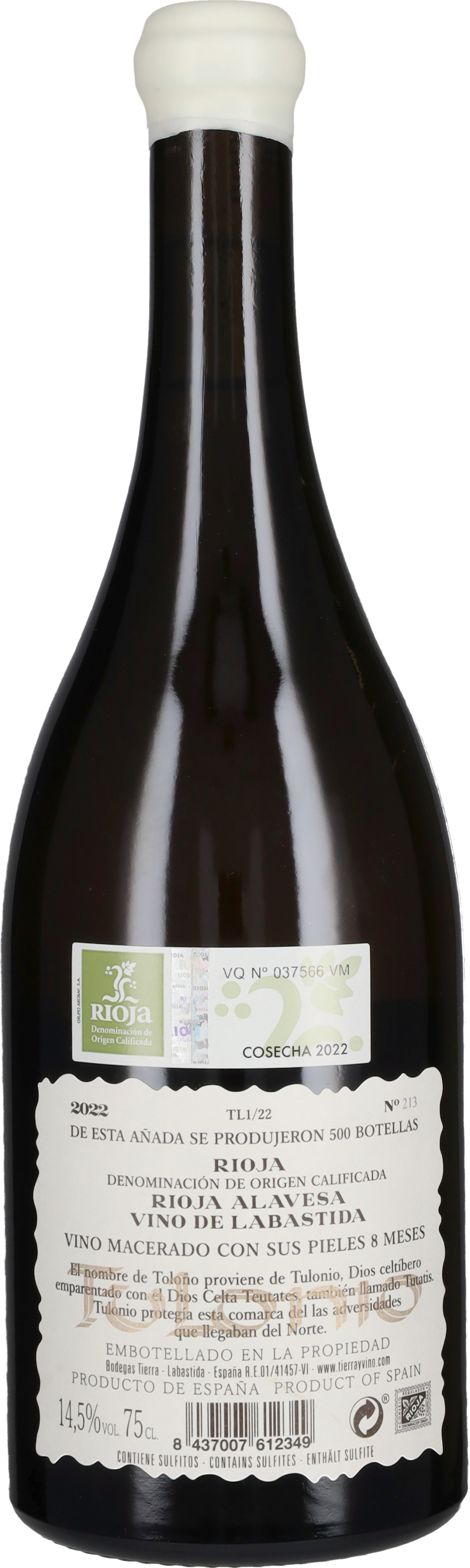
Tulonio Bodegas Tierra 2022The Rioja ‘Tulonio’ from Bodegas Tierra stands out as a refined expression of Cariñena Blanca in an orange version, crafted through an extended skin maceration. Cariñena Blanca, also known as Mazuelo Blanco and Carinyena Blanca, is a white grape variety that originated from a bud mutation of the more famous Cariñena Tinta, known in Sardinia as Carignano and in France as Carignan. Wines made from this grape are characterized by their rather full body and sustained acidity, but often have a bouquet that is not very expressive. This has led to the increasingly popular choice of vinifying it with a long contact between the must and the skins. Bodegas Tierra ‘Tulonio’ Rioja is a 100% Mazuelo Blanco whose grapes come from the El Convento vineyard, a plot planted in the early 2000s in the Labastida area of Rioja Alavesa. The harvest is carried out by hand in 14-kilogram boxes, accompanied by a careful selection of the bunches, which are then crushed whole in oval porcelain containers. Both the alcoholic fermentation and the maturation phase take place here, with a lengthy 8-month skin maceration. After this period, the wine is finally bottled in very limited quantities. The orange wine Rioja ‘Tulonio’ from Bodegas Tierra has an intense golden yellow color with bright orange hues. The glass reveals vivid aromas of grapefruit, macerated yellow flowers, aromatic herbs, undergrowth, and lavender, all enriched by mineral notes of limestone and light hints of wet earth. The taste is rich and flavorful, surprisingly lively, with a lovely freshness leading to a long and savory finish where the mineral sensations from the nose reappear.37,00 £*Shipping: 48,00 £Secure redirect to the provider
-
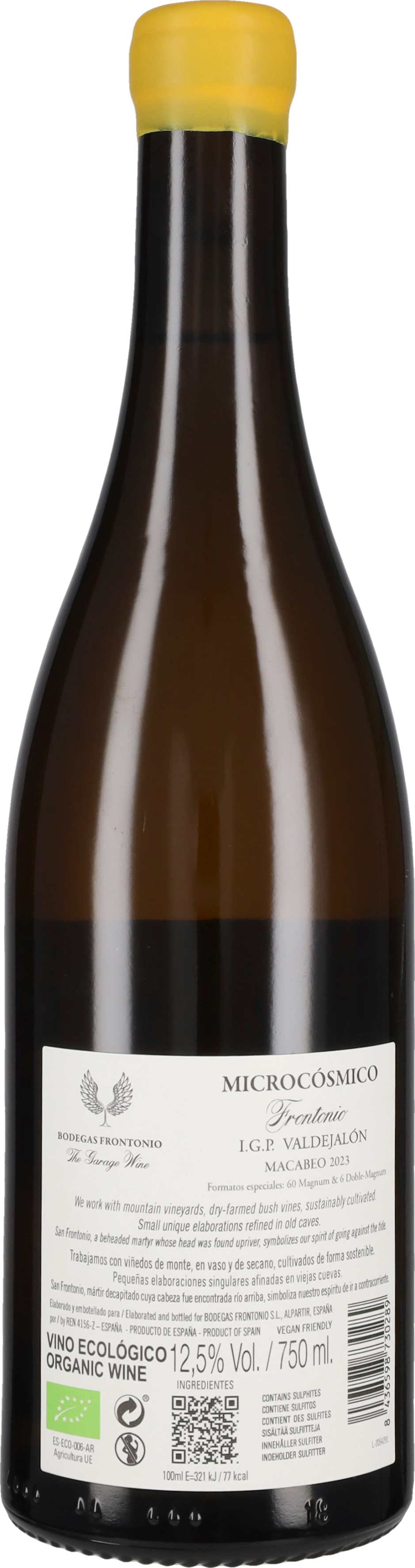
Macabeo 'Microcosmico' Bodegas Frontonio 2023The Macabeo "Microcosmico" by Bodegas Frontonio is produced near Zaragoza, Spain. The three founders Francisco Latasa, Fernando Mora, and Morio López shared the desire to produce wines with a quality that could distinguish them from others and make them unforgettable: the project started in an old winery with a selection of old grape varieties that would otherwise have been lost. Since 2008, wines have been produced following the traditions of the art of winemaking; in 2016, "El Jardin de Las Iguales" was purchased, with an estate of about 200 years and an underground cellar to facilitate and make special every phase of winemaking. The grapes of the Macabeo "Microcosmico" by Bodegas Frontonio grow in vineyards located about 530 meters above sea level, rooted in soils predominantly composed of limestone, for wines with a strong character. The plants have an average age of 65 years and ensure the sought-after quality in production, extending over about 10 hectares. The grape harvest is manual and takes place in the first days of the month of September; the bunches in the winery are destemmed and undergo a maceration of 20 hours without sulfur. Subsequently, an alcoholic fermentation occurs with indigenous yeasts in cement tanks for 15 days and ages underground also in cement for 6 months. The color of the Macabeo "Microcosmico" by Bodegas Frontonio is a light yellow with greenish reflections; on the nose, it releases aromas of jasmine, grape, and in the finish, mineral notes. On the palate, it is well-structured, elegant, and pervasive with a final freshness that is accommodating for delightful sips. It is recommended to pair with steamed fish dishes, mollusks, and crustaceans, also interesting with fresh cheeses. An excellent product to enjoy during summer aperitifs at sunset by the sea, to savor an authentic and genuine flavor, the result of constant and careful work.21,00 £*Shipping: 48,00 £Secure redirect to the provider
-
What are examples of natural landscapes and cultural landscapes?
Examples of natural landscapes include mountains, forests, deserts, beaches, and rivers. These landscapes are shaped by natural processes such as erosion, weathering, and tectonic activity. On the other hand, cultural landscapes are areas that have been influenced or shaped by human activity, such as cities, agricultural lands, parks, and historic sites. These landscapes reflect the interaction between humans and their environment over time. **
-
What is a question about the history of Romanesque architecture?
How did Romanesque architecture evolve from the earlier Carolingian and Byzantine styles? **
-
Can you help me with the art, culture, and history exam?
Of course! I can help you with the art, culture, and history exam by providing information, explanations, and answering any specific questions you may have. I can also assist in reviewing key concepts, important figures, and significant events related to these subjects. Feel free to ask me anything you need help with, and I'll do my best to assist you in preparing for your exam. **
-
What are expressionist landscapes?
Expressionist landscapes are a style of art that emphasizes the artist's emotional response to the natural world rather than a realistic depiction. These landscapes often feature bold colors, exaggerated shapes, and distorted perspectives to convey the artist's inner feelings and experiences. Expressionist artists use these techniques to evoke a sense of mood, atmosphere, and intensity in their landscapes, creating a subjective and highly personal interpretation of the natural world. **
* All prices are inclusive of VAT and, if applicable, plus shipping costs. The offer information is based on the details provided by the respective shop and is updated through automated processes. Real-time updates do not occur, so deviations can occur in individual cases. ** Note: Parts of this content were created by AI.